I’ve been riding my “new” 1980 Meral 650b for over a year now. Only recently has it become my bike of first choice, however. As with any bike, and especially with a frame-up build combined with a wheel size conversion (700c to 650b), there were a number of challenges and some disappointments. Here is an overview of the results:
Frame and Fork:

My favorite aspect of this bike is its beauty and the build quality of the frame and fork. It’s just an absolutely gorgeous, well put together bike. The Reynolds 531 tubing feels great and is not punishing, as can happen with stiff aluminum frames (especially smaller frames). I love the chrome accents and chrome fork, and the lovely sloping fork crown.

The deep purple color is eye catching and I like the gold lettering of the Meral logos, which goes with the gold-lined chrome lugs.

The frame geometry is suited for my riding preferences – with a steep seat tube and head tube angle. It has more stand over height than I really need, and if the frame were taller I would not have had to use a Nitto Technomic stem to get the bars at the height that feels good (slightly higher than the saddle height.) But, it wasn’t custom built for me, after all, so I’m not complaining.
Tires, Wheels, and Handling:

The Panaracer Col de la Vie 650b tires were extremely disappointing – to the point that I actually stopped riding this bike while I figured out what to do. They produced a lot of tire noise, and the deep treads picked up rocks like a vacuum cleaner, then spit them into the aluminum fenders, for an even greater cacophony. The tires felt squishy and ponderous no matter what pressures I tried, and made climbing feel like I was riding through quicksand. On descents, the bike was noticeably slower than ALL my other bikes, causing me to conclude that the tires had an enormous amount of rolling resistance. Since the tires come so highly recommended, I delayed changing them out while I tried out other theories to explain the bike’s slowness. Were the wheel hubs improperly adjusted? Was the freehub bad? No, and no.


In fact, I am really happy with this Velocity Synergy 650b wheelset. The hubs were adjusted perfectly right out of the box and are very smooth. I did have to make a small truing adjustment to the front wheel, and that was all. I ordered this 32 hole set from Rivendell and I think they were well worth the price (about $400 for the pair).
While I pondered what to do about the tires, I also had to contend with a problem that I had never experienced before to this degree: fork shimmy! The bike shimmied from the get-go, at high speeds and slow, and would get worse if I rode with just a single bag in back instead of two. So, I did a lot of reading about fork shimmy and found that it is as mysterious as “planing”, “q-factor” and bottom bracket drop in terms of facts vs. mythology. For instance, Jobst Brandt has a pretty scientific explanation of fork shimmy. Here is a quote from his treatise on the matter:
“Shimmy is not related to frame alignment or loose bearings, as is often claimed. Shimmy results from dynamics of front wheel rotation, mass of the handlebars, elasticity of the frame, and where the rider contacts the bicycle. Both perfectly aligned bicycles and ones with wheels out of plane to one another shimmy nearly equally well. It is as likely with properly adjusted bearings as loose ones. The idea that shimmy is caused by loose head bearings or frame misalignment seems to have established currency by repetition, although there is no evidence to link these defects with shimmy.”
He goes on to state that shimmy is caused by the gyroscopic forces of the front wheel, which combined with the tilt of the steering axis, exerts force on the top tube and downtube, causing them to oscillate. While absorbing this explanation, I read a number of other explanations, but none seemed as true to my mind as this. Based on that, I concluded that I definitely needed to replace the Panaracer tires because I felt they were contributing to, if not causing, the shimmy problem, with their deep tread pattern.

I finally broke down and ordered these Compass Loup Loup Pass 650b tires. I ordered the regular model, not the super-light. Conclusion: what took me so long! These are the best tires I have ever ridden, ever. They are comfortable, fast, quiet, and seem to help spur me up hills. I have ridden them on gravel, pavement, and over some bad and deep potholes. They are fabulous! Now, when I take the Meral out for a spin I find that I end up riding far longer than planned. They have restored my enjoyment of riding, and have really been the turning point in making this bike my favorite. And, I have absolutely no more fork shimmy, at any speed. So, I guess we can add tire tread depth and design as a possible contributor to fork shimmy – let the mythology continue!
Drivetrain:


The vintage TA triple crankset had a massive wobble so I had to disassemble it, place each chainring between two planks, and smash the hell out of them in my vise. It took enormous force to get them straightened, but now they are fine. The rings are 48/40/28. For this kind of bike, I really need some smaller rings up front, plus I prefer to have a 10 tooth difference between the big and middle rings. Rather than replace the TA rings, I decided to change the cassette. First of all, I had to accept the fact that I could not use an 8 speed cassette on this drive train – the Ultegra front derailleur could not handle it. Instead, I put in a spacer and ended up with this 14-32 7 speed cassette after trying 3 other cassettes that had higher gearing. I decided to stick with the Ultegra derailleur, though, because after doing much research I realized that it can be very difficult to find any front derailleur that will work with a TA crankset, due to its narrow tread. So, if it works, don’t fix it. The bike is geared a bit lower than my other bikes as it is a bit heavier, and I ended up replacing the SLX rear derailleur with the Deore pictured above which seems to work better with the larger cassette cogs. I am using my Shimano bar end shifters in friction mode and the shifting is fast and precise, with very little trimming needed. One of my favorite pieces on the bike is this modified Huret downtube clamp which can accept Shimano shifter pods – it looks great and the pods mounted precisely.
Braking System:


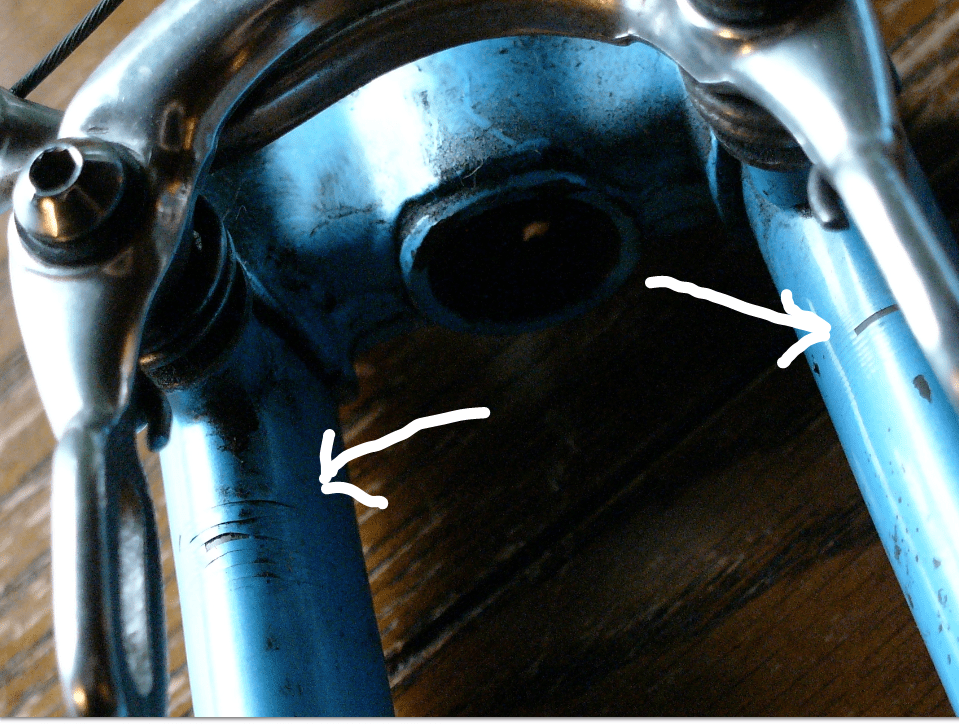
I used vintage Mafac Raid brakes to accomplish the conversion to 650b. This set was in nice shape and included all the mounting hardware. Because I was working with what was originally a sport touring bike, made long after these Mafac’s were manufactured, I had to make some modifications to the hardware to make things work. For the Mafac rear fender mount, I had to reverse the piece, tap out the other side, and mount it backwards in order to make it work with the brake bridge on this bike. I also “smooshed” the brake hanger and installed a longer seat post bolt to get the hanger to work with this bike. The brake arms are very long, as you can see, and naturally have a lot more flex due to the long reach. My Kool Stop replacement pads squealed like crazy for the first month or so of riding, and then finally everything settled down and braking is silent. However, the front brakes have a squishy feel, which is consistent with my experience with Mafac’s on other bikes I have ridden and restored. But, they get the job done, and that’s what matters. I am using Shimano aero levers, which fit comfortably in my hands – I use these for all my bikes with road bars.
Saddle, Rack, Bags, and Fenders:

The Cardiff saddle, a brand I haven’t tried before, turned out to be a real hit. It is breaking in nicely. It has longer seat rails than a Brooks, and a slightly different shape that seems to work well for me. The saddle is big enough to provide a number of different seating positions depending on where my hands are on the bars. In short, I will probably not go back to riding Brooks saddles as I find the Cardiff far more comfortable (comfort being a relative term when speaking of bike saddles…). And, it’s a pretty handsome saddle that goes perfectly with my plum-colored leather mud flap.


For my rear rack, I had wanted to use the Velo-Orange constructeur rack. It is very pretty and mounts to the rear fenders, which makes the rack sit down nice and low – ideal for carrying weight in the back. At the time I was building up the bike, that rack was out of stock, so I decided to try out the Electra Ticino rear rack instead. While the rack itself is not ugly, per se, it sits up very high, has unadjustable stays, and is very heavy. I sanded the stays to allow for greater adjustment so that I could level the rack (photo above is before I had done this), so that helped a bit. The Ticino panniers are nice bags, but are also very heavy and suffer from being oddly shaped. Nonetheless I have continued to use them and they have held up well.

Here is the bike now, after all these mods, and after a year of riding. It’s a very striking bike, and now a very comfortable bike after tweaking the components and upgrading the tires. Today, I meant to go out on just a short ride, but ended up two towns away! This bike has finally exceeded my expectations.

1980 Meral at Smith & Bybee Lakes