Resurrecting an Old Friend: a 1976 Centurion Pro Tour

1976 Centurion Pro Tour

I rode my 1976 Centurion Pro Tour for over 20 years before I crashed it back in 1999.  In fact, that crash and the resulting quest for a suitable replacement bike is what has led me here – to an appreciation of the rarity and quality of hand made vintage bicycles and to a side career as a bike mechanic, collector and restorer.

When I hit a car that had suddenly stopped in front of me while going about 20 mph, my front wheel collided with the car’s back end and I went down hard on the trunk.  (Thank you, helmet.)

fork damage

The fork legs were pushed back and the steerer tube was bent right above the crown.
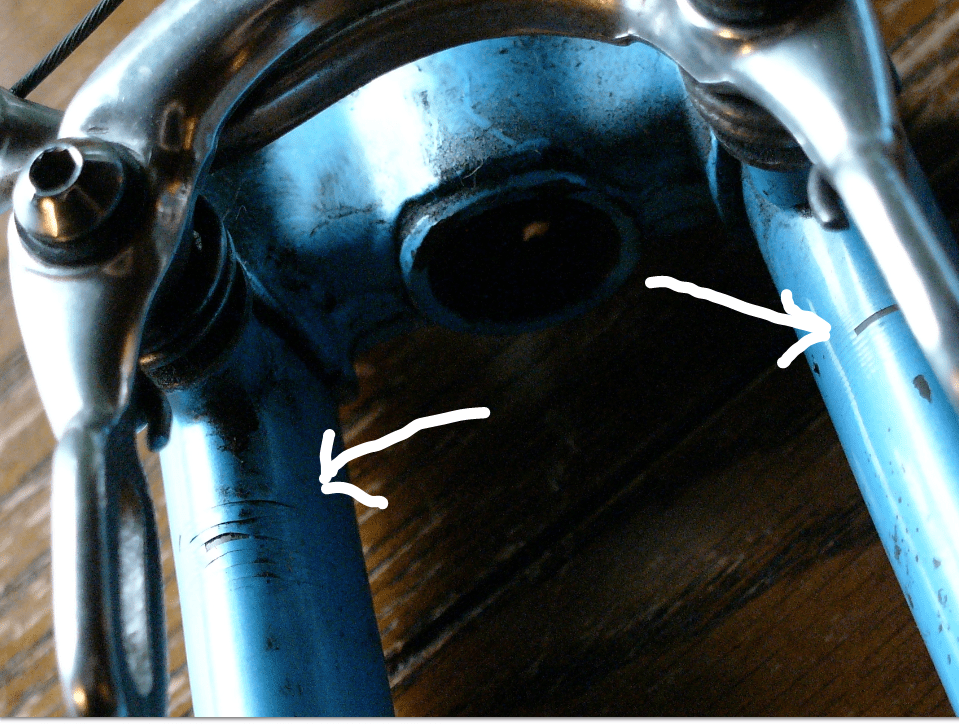
fork damage

You can see the tell-tale paint cracks which clearly indicate a sudden impact.  The fork was definitely toast.

frame damage annotatedframe damage annotated 2

The frame itself sustained some damage to the downtube (left photo) and top tube (right photo).  You can again see the tell-tale paint cracks right at the lug points, but the cracks are not very pronounced.  And, looking at the tubes and holding a straight edge up to them, I cannot see any significant bends or twists.

2013-09-27 001 003 2013-09-27 001 004 Suntour dropouts 2013-09-27 001 017 2013-09-27 001 005

The rest of the frame looks great, with plenty of “buesage” evident in the scratched paint and fading logos.  But, overall, this is one nice frame.  If I could bring this bike back to life with a new fork, and any needed repairs to the tubes, I would be overjoyed.  Interestingly, this frame is “too big” for me – at 54 cm, but I managed to ride all over the place in tremendous comfort.  I did install a stem with shorter reach, plus rando bars (which my Pro Tour did not have originally), and that gave me a comfortable position.  After all, with the really tall frame my stem didn’t need to be tall because it was already even with my saddle height.

Once I remove the paint (to reveal the fully chromed frame underneath!!!), I’ll know for sure the extent of the damage.  Since I am really fond of that baby blue color, I might still decide to paint it again after stripping it, but it will be sad to lose the Centurion logos.  An experienced painter may be able to recreate them.  If all goes well, I’ll be riding this amazing bike once again.

Touring in the San Juan Islands

Centurion Pro Tour – San Juan Islands – c. 1985

1940’s/50’s Goeland 650b

001 Here is a wonderful example of the work of Louis Moire, constructeur and founder of Goeland Cycles.  The idea behind Goeland was to offer a high quality hand built frame, but allow the customer to choose mid range components to help keep the cost reasonable.  Of course, high end components could also be chosen.  There isn’t much information about Goeland Cycles on the web, and there is definitely plenty of misinformation.  For example, one website claims that Goeland went out of business in the 1950’s.  Fortunately, I have a Daniel Rebour catalogue from 1962, where Goelands are prominently featured.  And, I have been able to confirm through various collectors that Goeland Cycles continued up until about 1970, having begun business in about 1935.  This Rene Herse site has some nice examples.

Goeland logoGoeland logo

One of my favorite things about Goelands are the beautiful logos.  Goeland means “gull” in french, and the headbadge and downtube logo feature a white seagull surrounded by clouds, flying over blue waves.   I can’t help but wonder if this name was chosen to combat the Raleigh Heron.

006005

The owner’s name tag is still intact (this was a requirement on all french bicycles of this era).  It would be fun if I could locate her family.  There is some confusion about the model year of this bike.  There are photos of this bike elsewhere on the web which identify the bike as a 1941 model, probably because there is a “41” stamped into the mounting tang of the rear rack.  However, based on discussions with the seller and by reviewing the components, I think it is probably more likely that this bike dates to the late 40’s or early 50’s.  Components include a Cyclo rear derailleur and shifter, Mafac cantilevers and levers, a Phillipe alloy bar and stem, Super Champion color matched aluminum fenders with JOS lamps, and a 650b wheelset with mystery steel rims and hubs, and a mystery freewheel as well.

011007004012

008009019

The original white rubber block pedals are lovely.  The crankset is unbranded except for this sweet logo of a bicycle stamped on the back side of the chain ring, along with “46” to indicate the number of teeth.

015 014 020 018

The frame’s lugs are very fancy, and there are lots of nice features such as braze-ons for the Radios dynamo, chain guard, and pump pegs, an RGF bottom bracket, as well as double eyelets front and rear.  And, there is blue box striping on almost all the tubes.  The paint is in very good condition for its age.

010

Unfortunately, there is damage to the frame – the drive side rack mount braze has failed.   There are also two other spots that need repairs as well:  the rack has one joint that needs re-brazing, and the sloping top tube lug has a small crack at the connection point to the seat tube (see below).  Sometimes it is hard to know whether one should proceed to make the repairs, not only because of the expense, but also because the bike will be “less original” when finished.

265767385_21c1fa3a8d

Even though I have completed a frame building class, I know that I am not the one to do these repairs.  Frame building and this kind of problem solving are best left to those with many years of experience.  Fortunately, I have my favorite builder and I am hoping that he will help me select the right frame painter for this project.  The frame only needs to be re-painted in the areas where the repairs are made, fortunately not anywhere near the logos.

017While the frame is being repaired and the paint touched up where needed, I can start cleaning and overhauling the components.  A project like this can have many stops and starts, but I hope I can have this one completed before the end of the year.  My goal, of course, is not only to preserve this rare machine but to also make it rideable again.  While not a bike I will ride regularly, I plan to keep it in my permanent collection, for now.

1930’s/40’s Peugeot Mixte 650B – Part II

2013-04-16 002

bike shop 003

I have just about finished my recreation of this 1930’s/40’s Peugeot Mixte.  The bike was incomplete, as shown above, so I set about locating the appropriate parts to bring this old bike back to life and to make it rideable.  Right now, the bike looks great, but there’s a little more work to do on making the braking system stop the bike effectively.

This particular model is built with Rubis tubing – a Vitus brand that was used on higher end bicycles beginning in the 1930’s.  Unfortunately, over a decade of Peugeot bicycle catalogs are not available – from 1937 to 1950 – so it is not possible to determine which model this is, or what year.  During the war years, the Peugeot factory was under German control for a time, and there is very little information available as to what was happening in the cycling industry during the German Occupation. The serial number at the left rear drop-out includes an “H” so it is likely this is an H model.

The frame was in remarkably good condition, with all the brazing intact.  Although I tentatively dated the frame to the late 1930’s, I believe that it was later upgraded with the 1940’s or 1950’s Simplex Tour de France derailleur that was included when I purchased it. The frame has braze-ons for an earlier style of derailleur, however.

2013-04-16 001 2013-04-16 0052013-04-16 001 2013-04-16 006

I wanted to use the 4 speed freewheel shown above, but the Simplex TDF derailleur did not have enough cage swing capacity to cover all 4 cogs.  In fact, it measured out as exactly equal to the 3 cog freewheel shown above right, meaning of course that it was built as a 3 speed derailleur.  In a separate post, I discuss the procedures and issues related to setting up a Simplex Tour de France rear derailleur – no small feat.

2013-04-16 013

Through the frame cable routing, Jeay brakes

2013-04-16 008

Simplex shifter

2013-04-16 014

Possibly the original pump

2013-04-16 012

Another view of the Jeay brake cable routed through the frame – a nice touch.

2013-04-16 011

Full chainguard with blue pinstriping. The crankset and pedals are very lightweight – pedals are aluminum but unbranded.

2013-04-16 010

Peugeot logo still very vibrant


Vitus Rubis tubing

Vitus Rubis tubing

2013-04-16 007

Pin striping still evident on the fork legs. The wheels are not original, nor are the fenders.

2013-04-16 006

Jeay Brakes

2013-04-16 004

Headtube badge in nice condition

2013-04-16 005

The aluminum bars with wood grips and custom aluminum levers were a perfect addition to bring this bike back to its glory.

I harvested the 650b fenders and wheels from another French rando bike.  The hubs are by Normandy laced to 650b Wolber Super Champion rims. The aluminum fenders are unbranded.  The frame has some nice features, including the braze-ons for the Jeay brakes and the thru-the-frame cable routing for the rear brake.  I still need to install the rear and head lamps on the fenders and mount the dynamo, and get the lighting wired up.  But that can happen after its first test ride, coming soon.